
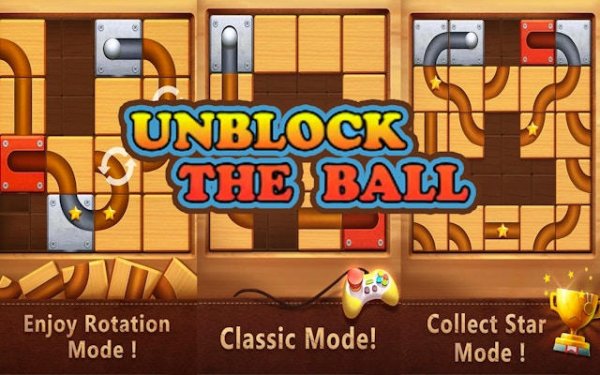
Sliding Blocks to Shape a Path
Each puzzle presents a grid filled with movable pieces. Your job is to slide those pieces until a continuous route exists between the ball's starting position and the green goal block. The ball then rolls along the cleared route automatically, so the real work happens before it moves. Because every slide changes the board, the order of your moves matters as much as the moves themselves.
Fixed Obstacles and Holes
Not everything on the grid can be shifted. Fixed metallic blocks stay in place and act as permanent walls, forcing you to route around them. Holes are equally unforgiving: if the ball rolls into one, the attempt ends. These two elements turn simple sliding into a spatial reasoning task, since a path that looks open may still funnel the ball toward a gap you overlooked.
Planning Several Moves Ahead
Early levels show their solution quickly. Later layouts require you to think in sequences, because a block you move now may be needed elsewhere two or three moves later. Reversing a poor decision is not always possible without restarting, which encourages players to study the whole board before touching anything. The difficulty curve comes from layout complexity rather than new rules, keeping the learning process gentle.
Stars, Offline Play, and Updates
A three-star challenge system rewards efficient solutions, giving players a reason to replay a solved puzzle for a better route. The game supports relaxed offline play, so sessions fit into short breaks or longer stretches of logical thinking. Regular updates may add fresh content, though the core loop stays consistent.






Comments
0 comments