
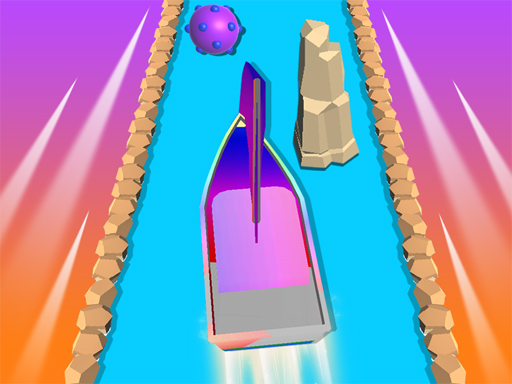
Steering Through a Narrow Waterway
The entire game rests on a single input: move left or right. Your ship travels forward automatically through a winding 3D channel, and you adjust its lateral position to slip past rocks and buoys. There is no throttle, brake, or camera control to manage, which keeps the focus squarely on timing and spatial judgment. The waterway curves, so the safe line through each hazard cluster changes constantly. Reading the next few seconds of the path matters more than reacting to what is directly in front of you.
One Mistake Ends the Run
Contact with any hazard stops the run immediately. There are no health bars, shields, or second chances within a single attempt. That rule gives every input weight: a late correction or an overcorrection that sends you into a buoy costs the entire run, not just a portion of it. Because failure is binary and instant, the game rewards conservative, smooth steering over aggressive last-second dodges. Restarting is quick, so a failed attempt naturally leads into another.
Escalating Speed and Density
As you survive longer, the ship moves faster and the path becomes more crowded with obstacles. The two changes compound: hazards arrive sooner and the gaps between them shrink. Early sections give you room to learn the steering feel, while later sections demand faster recognition and smaller adjustments. This steady ramp is the main source of long-term challenge, and it means a run that felt comfortable a minute ago can turn punishing without any new mechanic appearing.
Score-Chasing and Replay Value
There is no finish line described; the structure is built around beating your previous distance or score. That framing turns each attempt into a measurement of improvement rather than a story to complete. Bright, colorful visuals keep the waterway readable at speed, and the game is designed to run on a range of devices with mouse or touch input. Sessions can be short, which suits the pick-up-and-play arcade format.








Comments
0 comments